Natural search as a key growth lever
Why natural search remains an SME's most profitable channel, its four levers, what it changes on leads, and where to start.
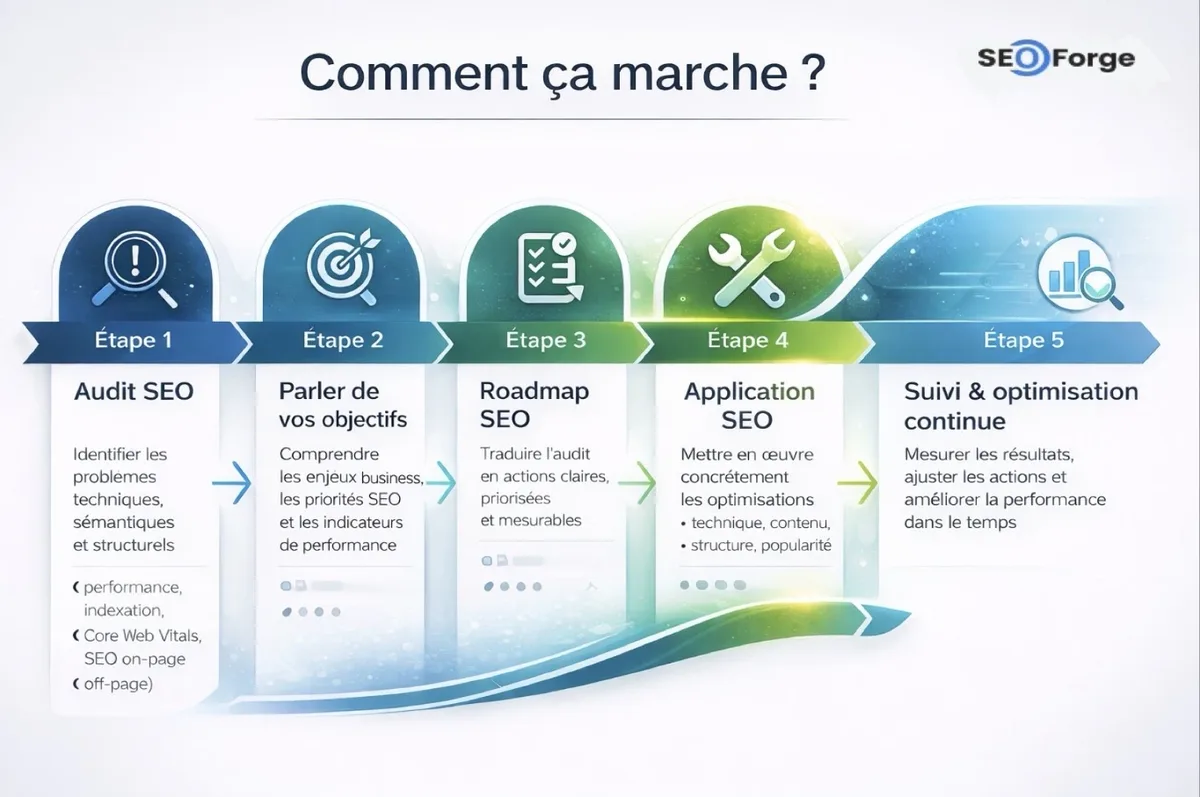
Natural search is an SME's most profitable acquisition channel over time: it costs nothing per click, it keeps producing when you stop working on it, and it reaches people actively looking for what you sell. Yet it is most often poorly used.
Most SMEs have a working, sometimes polished website that does not show up when a potential customer types their need into Google. The site exists; it does not work for you. This article explains why, what SEO concretely changes for a business, and where to start without spending your evenings on it.
Why SEO is still a growth lever in 2026
A Google search is an intent. Someone typing "heating engineer Nantes" or "quoting software for tradespeople" has a need, now. Being there at that moment is worth more than any ad shown to people who are not looking for anything.
- Organic traffic is not paid per click: a well-ranked page receives visits every month without media budget.
- Results are cumulative: every fixed page, published piece of content and earned link stays in place.
- Trust is higher: organic results are perceived as a recommendation, not an ad.
- The data works everywhere: queries that convert in SEO feed your Google Ads campaigns, and vice versa.
SEO is not fast. That is its only real limit, and it is why it pairs so well with advertising: Google Ads brings the first leads while organic rankings are being built.
The four levers of natural search
SEO comes down to four families of actions. An SME does not need to master them all at once, but it must know which one is blocking.
1. Technical. Google must be able to crawl, understand and render your pages. A misconfigured robots.txt, slow pages, redirect chains or an outdated sitemap are enough to make a site invisible, whatever its content. It is the first thing to check, and the purpose of a technical SEO audit.
2. Performance. Loading speed is an official ranking factor through the Core Web Vitals, and above all a conversion factor: a visitor waiting three seconds on mobile leaves. A fast site serves SEO and paid campaigns at the same time.
3. Content and pages. Each page must answer one precise search intent, with a clear title, a readable structure and consistent internal linking. That is the job of on-page SEO: making your pages speak your customers' language, not your org chart's.
4. Authority. Links from other sites, reviews, mentions and the Google Business Profile listing strengthen your domain's credibility. For an SME, a few quality links earned naturally (partners, local press, serious professional directories) are worth more than hundreds of bought links.
What SEO concretely changes for an SME
The right indicator is not the position on a keyword; it is the number of inbound requests and what they cost. A site well ranked on its market's queries receives quote requests, calls and sign-ups without additional ad spend, and lowers the average cost per prospect when combined with paid campaigns.
- More qualified leads: visitors arrive with an intent, not by chance.
- Less dependence on media budget: rankings stay when campaigns stop.
- Better Ads profitability: a fast, clear site converts paid clicks better.
- A clear view: rankings, traffic, leads and cost per prospect tracked in one report.
How long, and how much?
Technical fixes act within weeks on indexation. Lasting rankings on competitive queries generally take three to six months. Well-designed content can rank faster on niche queries where competition is low.
On budget, the French market charges between €1,000 and €3,000 excl. VAT for an audit and between €800 and €3,000 excl. VAT per month for ongoing work. We built our offers to be readable: a Growth Audit at €690 excl. VAT, a 90-day Sprint to deliver the fixes, and Monthly management that runs SEO and Google Ads together. If you hesitate between organic search and ads, our SEO or SEA comparison details the differences.
Price ranges observed by SEOForge in the French market. Updated: .
Where to start
In this order, because each step conditions the next:
- Measure: current rankings, organic traffic, requests received. Without a starting point, no result can be judged.
- Fix the technical side: indexation, speed, errors. This is what unblocks everything else.
- Rewrite the pages that matter: services, offers, contact, with one search intent per page.
- Publish what your customers are looking for: a few useful pieces beat an abandoned blog.
- Track every month and adjust: the budget follows what works.
A free first diagnosis
You can test your site for free online to get its performance scores and main SEO points in a few tens of seconds. And if you want to know where to start, describe your site and your goal: an expert replies within one business day with what they see, even if the answer is "you do not need us".

Author of this article.
Read next
How We Implemented GEO on Our Own Site
robots.txt open to AI crawlers, entity schema against namesakes, llms.txt generated from routes, honest dates: our GEO implementation in detail.
Read more
On-Page SEO Checklist: 15 Points to Optimize Your Pages
Discover the 15 essential on-page SEO checklist points to optimize your web pages: title tags, meta descriptions, heading structure, internal linking and more.
Read more